Classes
The airspace is divided into altitude ranges.
In France, there are 6 classes of airspace. The first five, A, B, C, D, E are controlled. The last one, G is uncontrolled: G. For free flight, it's class E or G, the other classes are strictly forbidden.
But...: above 3450m (FL115), the space is automatically classified as D and therefore... prohibited, unless you're within 1000m of the ground. Over the Alps and Pyrenees, considering the relief, under the condition that you are well within a LTA (Lower Traffic Area), you can be in class E up to 5850m (FL195) and roll all that passes.
The following diagram presents a summary of VMC (Visual Meteorological Conditions) conditions according to flight altitude and presence of reliefs.
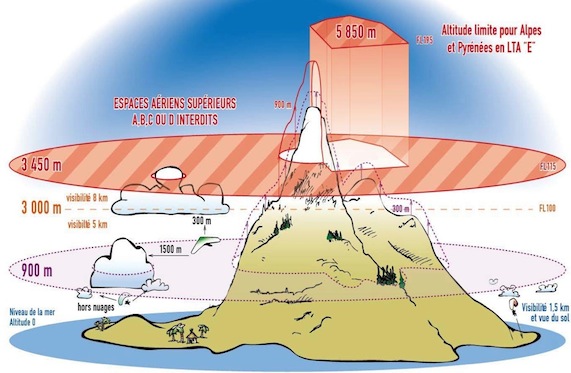
Classes will be listed in ascending order of constraint.
Class G
G as General. This is the class where nothing happens, where everyone is free to perform their evolutions within the rules of the air. IFR and VFR are not controlled; only information on known traffic is provided, and each pilot takes care to ensure collision avoidance. By default, below level 115, you're in class G.
Class E
The first of the controlled classes. Used for guiding the trajectories of low-traffic IFR flights, which receive control services so they are separated from each other. In general, class E is found around small airports or at the periphery of international airport spaces. VFR can freely access this space as long as it respects VMC conditions, i.e., deviating from clouds to see and avoid these IFR flights.
The VFR flight is not subject to clearance and radio contact is not mandatory in this class of airspace. However, IFR flights being controlled, they are obligated to establish radio contact and obtain clearance to enter an E space.
Class D
From now on, the VFR is controlled, i.e., it's subject to radio contact and clearance before entering. If the controller handles caps and levels for separating IFRs among themselves, the control service between IFR/VFR and VFR/VFR limits itself to providing assistance to pilots to ensure see and avoid as soon as separation risks falling below the norm.
Class C
The VFR is controlled with radio contact and clearance delivery. This class is used in France within the "core" of large airport spaces (Bordeaux, Toulouse, Marseille, Nice, and Lyon). As commercial traffic is more intense, the controller's mission is to ensure that IFRs and VFRs are separated by at least the regulatory minimum. Several tools are at their disposal: imposed flight routes, levels, and caps.
Class B
VFR allowed; radio contact and clearance for entry into space are mandatory. It is no longer used in French airspace.
Class A
Reserved for IFR unless expressly authorised otherwise. Radio contact and clearance for entry into the space are mandatory. Used in high-traffic spaces associated with airports such as those around Paris: Roissy-Charles de Gaulle, Orly, and Base aérienne 107 Villacoublay.