Zones
By default, below FL115, we are in space G, so in principle open to paragliders. However, for the purposes of air traffic, areas with special status are defined.
Airports
An airport will be protected by different zones:
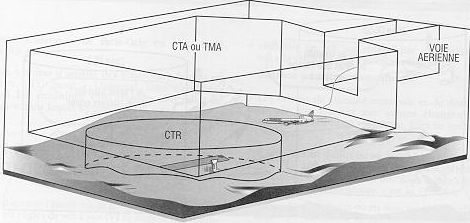
- a CTR (ConTrol Region), which is a controlled airspace within a volume defined at the ground, extending vertically from the surface to a specified upper limit. In France, CTs are generally class D, except in the Paris region where they are class A. The lower limit of a CTR is always the ground.
- a TMA (TerMinal Area), which will be defined above the CTR for the descent and ascent of aircraft. They can often extend to more than 50 km from the airport. In France, most TMAs are class D or E, but some high-traffic IFAs are class C or even A like above the Paris region where circulation is forbidden to VFR flights unless derogation.
Most of the time located above one or more CTs, their horizontal limits are at least 700 feet above ground level, while their ceiling is very variable depending on the zones. The lower limit of a TMA is never the ground. - a CTA (Control Traffic Area) is used to define an area overlying important airports and medium-sized airports.
- AWY (AirWaY) routes, which are classified as minimum E. They are used to access TMAs and CTs
Zones with special status
Very widely used by the military for protection of their evolutions, but there also exist ones for civil needs.
Danger zones:
They are defined to announce a permanent or temporary danger for aircraft. Penetration into the zone is not forbidden even during activity. For example, areas with many cables (Génissiat Dam, etc.). Not to be confused with Class D airspace.
Regulated zones:
These regulated areas are defined to protect an area, mainly for military aircraft evolutions. In France, there exists a very low altitude network (RTBA) traversed at high speed. Aircraft flying in this type of zone do not ensure anti-collision with other aircraft. Each airbase has one or more areas where its planes can train. They can be active or not, information is given by Notam or by phone. If the area is active, according to zones and depending on the flight rule used, penetration is: * forbidden: Air Force combat training zone, RTBA network * allowed following instructions from the zone manager: approach zone of certain military airports * allowed after simple radio contact.
Non-activated, it's as if these zones didn't exist.
Prohibited zones:
Nominated P for Prohibited, they are completely forbidden to all civil aircraft. They are few in number. The most known is P 23 established around Paris which prohibits flying over Paris until 6600 feet above sea level
Temporary Zones:
ZIT
Established temporarily around particular buildings, industrial petrochemical or nuclear sites, or specific events to prohibit access by unauthorised aircraft.
ZRT
Established temporarily around particular buildings or specific events, establishing a special regulation (obligatory radio contact, obligatory transponder, transit altitude...).