Regulation
Free flight pilots have long ignored airspace, considering it to be ‘reserved’ for real aircraft. Given the evolution of paraglider performance, the playing field has significantly expanded, particularly in flat areas. It is now impossible to envision ambitious flights without taking into account aeronautical regulations.
In paragliding, we fly according to Visual Flight Rules (VFR):

It's good to know and understand the units used in all aeronautical documents issued according to international aeronautical rules (OACI)
- English language and measurements
- Time in Universal Time (UTC) or Coordinated Universal Time
- Units of measurement = feet, knots, and nautical miles
- 1 ft = 30 cm => 100 ft = 30 meters
- Conversion = X3 + /10 (1000 ft = 300 meters)
- ASFC = Above Surface Level
- AGL = Above Ground Level
- AAL = Above Airport Level
- AMSL = Above Medium Sea Level
- FL = Flight Level
- QFE = reference 0 at takeoff/landing
- QNH = Actual Altitude
- FL = Altitude Pressure 1013
| Reference | Type | Unit | Calibration | Conversion |
|---|---|---|---|---|
| ASFC, AGL, AAL | Height | 1 ft | QFE | 1000 ft = 300m |
| AMSL or none | Altitude | 1 ft | QNH | 100 ft = 30m |
| FL | Flight Level | 100 ft | 1013 hPa | FL100 = 3000m |
This diagram summarizes the Visual Meteorological Conditions rules:
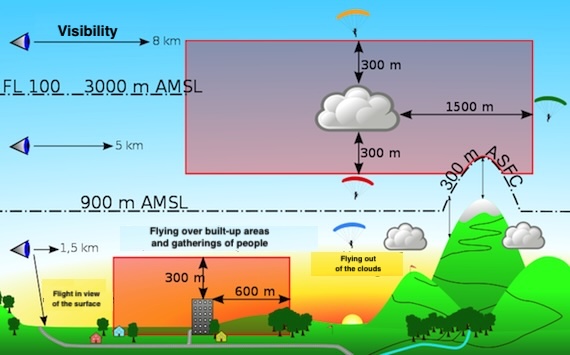
This illustration summarizes the variable constraints according to flight altitude:
- Below 900 meters
- Between 900 and 3000 meters
- Above 3000 meters
For areas with high population density (cities, agglomerations, gatherings of people), fly 300 meters above the highest obstacle within a radius of 600 meters. Elsewhere, the minimum height of 150m is no longer imposed on PUL. However, a minimum height may be imposed over a protected area (national park, reserve, ZIT) ranging from 300 to 1000 meters depending on the case.
Division of Airspace
To ensure separation of traffic and avoid difficult cohabitation between commercial, military, and recreational aviation, a very strict regulation has been adopted.
Vertically, airspace has been divided into classes that can be controlled or not. The Classes page details this regulation.
Horizontally, for the needs of air traffic, areas with various classes of space have been defined. They are listed on the Zones page specific to each type.